hifa_wvrgcalflag
Note
Parameters set to None will use intelligent defaults from the pipeline context.
Pass explicit values to override context defaults.
- hifa_wvrgcalflag(vis=None, caltable=None, offsetstable=None, hm_toffset=None, toffset=None, segsource=None, sourceflag=None, hm_tie=None, tie=None, nsol=None, disperse=None, wvrflag=None, hm_smooth=None, smooth=None, scale=None, maxdistm=None, minnumants=None, mingoodfrac=None, refant=None, flag_intent=None, qa_intent=None, qa_bandpass_intent=None, accept_threshold=None, flag_hi=None, fhi_limit=None, fhi_minsample=None, ants_with_wvr_thresh=None, parallel=None)[source]
Generate and apply a WVR phase correction table, flagging antennas with bad radiometers.
Water Vapor Radiometer (WVR) sky brightness temperature measurements in four sub-bands surrounding the 183 GHz water line are converted by the CASA task
wvrgcalinto a phase correction table. The phase rms during observation of the bandpass calibrator, measured with and without the WVR correction, is used to (1) detect poorly performing WVR units on individual antennas and (2) determine whether the overall WVR correction is beneficial.For heterogeneous arrays the task will only attempt a correction if at least
ants_with_wvr_nr_thresh(default: 3) 12-m antennas have WVRs and the fraction of WVR-equipped antennas is at leastants_with_wvr_thresh(default: 0.2). If these thresholds are not met, no WVR caltable is created.For each qualifying MS the workflow is:
Generate a gain table from the WVR data.
Apply the WVR calibration to the data specified by
flag_intent; compute per-scan flagging views showing the ratiophase-rms(with WVR) / phase-rms(without WVR)— a ratio < 1 indicates improvement.Search the views for antennas with anomalously high ratios. If found, recalculate the WVR calibration with those antennas excluded (
wvrflag), interpolating results from nearby antennas withinmaxdistm(default: 500 m) provided at leastminnumants(default: 2) are available.If after flagging the remaining WVR-equipped antennas fall below the count/fraction thresholds, reject the WVR caltable and do not use it in subsequent calibration.
If the overall QA score exceeds
accept_thresholdthe WVR caltable is merged into the context.
For heterogeneous arrays, 7-m (CM) antennas are never removed from the reference antenna list.
The WebLog shows the effects of the phase correction, which antennas (if any) had their WVR data flagged, per-antenna path-length RMS ('RMS') and channel-to-channel discrepancy ('Disc') values, and a warning if the correction is not helpful enough to apply.
- Parameters:
vis --
List of input visibility files. Default: none, in which case the vis files to be used will be read from the context.
Example:
vis=['ngc5921.ms']caltable --
List of output gain calibration tables. Default: none, in which case the names of the caltables will be generated automatically.
Example:
caltable='ngc5921.wvr'offsetstable --
List of input temperature offsets table files to subtract from WVR measurements before calculating phase corrections. Default: none, in which case no offsets are applied.
Example:
offsetstable=['ngc5921.cloud_offsets']hm_toffset -- If 'manual', set the 'toffset' parameter to the user-specified value. If 'automatic', set the 'toffset' parameter according to the date of the MeasurementSet; toffset=-1 if before 2013-01-21T00:00:00 toffset=0 otherwise.
toffset -- Time offset (sec) between interferometric and WVR data.
segsource -- If True calculate new atmospheric phase correction coefficients for each source, subject to the constraints of the
tieparameter.segsourceis forced to be True if thetieparameter is set to a non-empty value by the user or by the automatic heuristic.sourceflag --
Flag the WVR data for these source(s) as bad and do not produce corrections for it. Requires
segsource=True.Example:
sourceflag=['3C273']hm_tie -- If 'manual', set the
tieparameter to the user-specified value. If 'automatic', set thetieparameter to include with the target all calibrators that are within 15 degrees of it: if no calibrators are that close thentieis left empty.tie --
Use the same atmospheric phase correction coefficients when calculating the WVR correction for all sources in the
tie. Iftieis not empty thensegsourceis forced to be True. Ignored unlesshm_tie= 'manual'.Example:
tie=['3C273,NGC253', 'IC433,3C279']nsol -- Number of solutions for phase correction coefficients during this observation, evenly distributed in time throughout the observation. It is used only if segsource=False because if segsource=True then the coefficients are recomputed whenever the telescope moves to a new source (within the limits imposed by 'tie').
disperse -- Apply correction for dispersion. (Deprecated; will be removed)
wvrflag --
Flag the WVR data for these antenna(s) as bad and replace its data with interpolated values.
Example:
wvrflag=['DV03','DA05','PM02']hm_smooth -- If 'manual' set the 'smooth' parameter to the user-specified value. If 'automatic', run the wvrgcal task with the range of 'smooth' parameters required to match the integration time of the WVR data to that of the interferometric data in each spectral window.
smooth -- Smooth WVR data on this timescale before calculating the correction. Ignored unless
hm_smooth='manual'.scale -- Scale the entire phase correction by this factor.
maxdistm --
Distance in meters of an antenna used for interpolation from a flagged antenna. Default: -1 (automatically set to 100m if >50% of antennas are 7m antennas without WVR and otherwise set to 500m).
Example:
maxdistm=550minnumants --
Minimum number of nearby antennas (up to 3) used for interpolation from a flagged antenna.
Example:
minnumants=3mingoodfrac --
Minimum fraction of good data per antenna.
Example:
mingoodfrac=0.7refant --
Ranked comma delimited list of reference antennas.
Example:
refant='DV02,DV06'flag_intent -- The data intent(s) on whose WVR correction results the search for bad WVR antennas is to be based. A 'flagging view' will be calculated for each specified intent, in each spectral window in each vis file. Each 'flagging view' will consist of a 2-d image with dimensions ['ANTENNA', 'TIME'], showing the phase noise after the WVR correction has been applied. If flag_intent is left blank, the default, the flagging views will be derived from data with the default bandpass calibration intent i.e. the first in the list BANDPASS, PHASE, AMPLITUDE for which the MeasurementSet has data.
qa_intent -- The list of data intents on which the WVR correction is to be tried as a means of estimating its effectiveness. A QA 'view' will be calculated for each specified intent, in each spectral window in each vis file. Each QA 'view' will consist of a pair of 2-d images with dimensions ['ANTENNA', 'TIME'], one showing the data phase-noise before the WVR application, the second showing the phase noise after (both 'before' and 'after' images have a bandpass calibration applied as well). An overall QA score is calculated for each vis file, by dividing the 'before' images by the 'after' and taking the median of the result. An overall score of 1 would correspond to no change in the phase noise, a score > 1 implies an improvement. If the overall score for a vis file is less than the value in 'accept_threshold' then the WVR calibration file is not made available for merging into the context for use in the subsequent reduction.
qa_bandpass_intent -- The data intent to use for the bandpass calibration in the qa calculation. The default is blank to allow the underlying bandpass task to select a sensible intent if the dataset lacks BANDPASS data.
accept_threshold -- The phase-rms improvement ratio (rms without WVR / rms with WVR) above which the wrvg file will be accepted into the context for subsequent application.
flag_hi -- True to flag high figure of merit outliers.
fhi_limit -- Flag figure of merit values higher than limit * MAD.
fhi_minsample -- Minimum number of samples for valid MAD estimate.
ants_with_wvr_thresh -- This threshold sets the minimum fraction of antennas that should have WVR data for WVR calibration and flagging to proceed; the same threshold is used to determine, after flagging, whether there remain enough unflagged antennas with WVR data for the WVR calibration to be applied. Example:
ants_with_wvr_thresh=0.5parallel --
Process multiple MeasurementSets in parallel using the casampi parallelization framework.
Options:
'automatic','true','false',True,FalseDefault:
None(equivalent toFalse)
- Return type:
ResultsList[Results]
Notes
QA is produced per MS via a two-stage metric:
Stage 1: assess the RMS improvement ratio for BANDPASS and PHASE calibrator sources. The CASA log lists the ratios of with-WVR phase RMS / without-WVR phase RMS (i.e. 1 / improvement). If the PHASE calibrator has low SNR with phase RMS > 90 deg on longer baselines, it is excluded and only the BANDPASS improvement ratio is used.
Stage 2: cap the score for issues such as flagged antennas, RMS or Disc values > 0.5 mm, low SNR, or high atmospheric phase variation. The final score is determined by fixed-range linear fits from the scoring tree shown below.
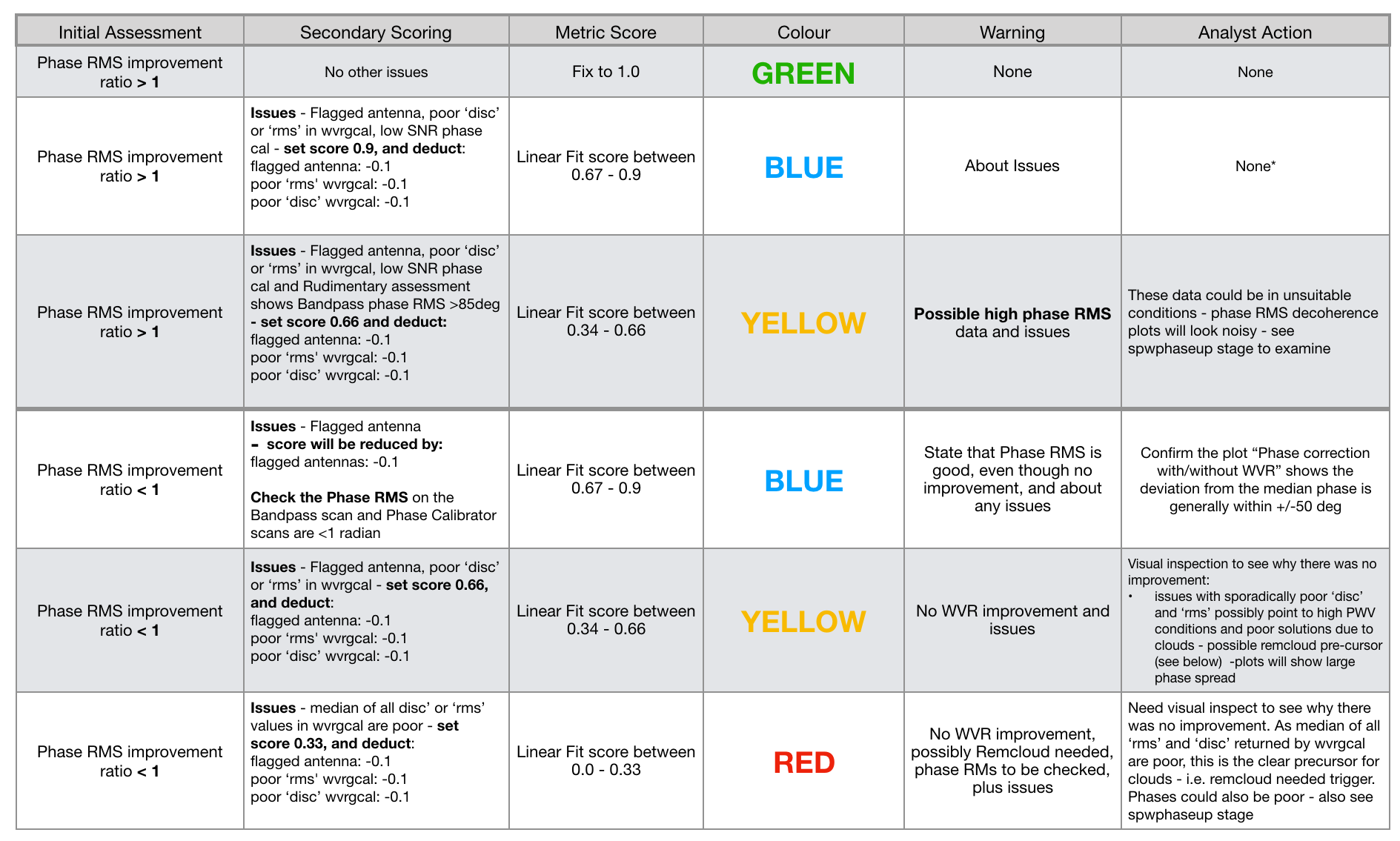
QA scoring workflow showing initial and secondary scoring criteria, the resulting QA metric score range and corresponding color, the meaning of each score, and instructions for QA analysts reviewing the WebLog.
The final stage score is the lowest score across all MeasurementSets.
- Returns:
The results object for the pipeline task is returned.
- Return type:
ResultsList[Results]
Examples
Compute the WVR calibration for all the MeasurementSets:
>>> hifa_wvrgcalflag(hm_tie='automatic')