hif_makeimages
Note
Parameters set to None will use intelligent defaults from the pipeline context.
Pass explicit values to override context defaults.
- hif_makeimages(vis=None, target_list=None, hm_masking=None, hm_sidelobethreshold=None, hm_noisethreshold=None, hm_lownoisethreshold=None, hm_negativethreshold=None, hm_minbeamfrac=None, hm_growiterations=None, hm_dogrowprune=None, hm_minpercentchange=None, hm_fastnoise=None, hm_nsigma=None, hm_perchanweightdensity=None, hm_npixels=None, hm_cyclefactor=None, hm_nmajor=None, hm_minpsffraction=None, hm_maxpsffraction=None, hm_weighting=None, hm_cleaning=None, tlimit=None, drcorrect=None, masklimit=None, cleancontranges=None, calcsb=None, hm_mosweight=None, overwrite_on_export=None, vlass_plane_reject_im=None, parallel=None)[source]
Create cleaned images from the target list populated by
hif_makeimlist.Images are deconvolved using
tcleanwith theauto-multithreshauto-masking algorithm (Kepley et al. 2020). Two thresholds,sidelobethresholdandnoisethreshold, control the masking at each minor cycle. For continuum imaging, if auto-masking prunes all regions, a fallback mask at the 0.3 primary beam response level is used. Cube imaging stages do not apply this fallback.Images are cleaned to 2 x (predicted rms noise) x (dynamic range correction factor), where the DR factor accounts for imaging artifacts at high dynamic range. For 12-m array calibrators the factor is 1 (DR <= 1000), DR/1000 (1000-3000), or DR/3000 (>= 3000). For 7-m array (1 EB) it is 1 (DR <= 200) or DR/200 (>= 200). For 12-m array science targets the factor ranges from 1 (DR <= 20) up to max(2.5, DR/150) (DR >= 150). The dynamic range correction factor is shown next to each image in the WebLog.
The
auto-multithreshparameters depend on array and configuration:Parameter 7m 12m b75<300m 12m b75=300-400m 12m b75>400m noisethreshold 5.0 4.25 5.0 5.0 sidelobethreshold 1.25 2.0 2.0 2.5 lownoisethreshold 2.0 1.5 1.5 1.5 minbeamfrac 0.1 0.3 0.3 0.3 fastnoise False False False True
For cube imaging, an additional QA score assesses line contamination in line-free channels by computing
mom8_fc(max along freq axis) andmom10_fc(min) images of the line-free channel ranges. Three metrics are evaluated:PeakSNR,HistAsym, andMaxSeg. If PeakSNR > 5 and HistAsym > 0.2, or PeakSNR > 3.5 and HistAsym > 0.05 and MaxSeg > 1 beam area, the QA score is in the range 0.33-0.65 (yellow); otherwise 0.67-1.0.For check sources, additional Gaussian-fit-based QA is computed: positional offset from the catalog, peak/total flux ratio, and fitted/
gfluxscaleflux ratio. The final check source QA score is the geometric mean of the three sub-scores.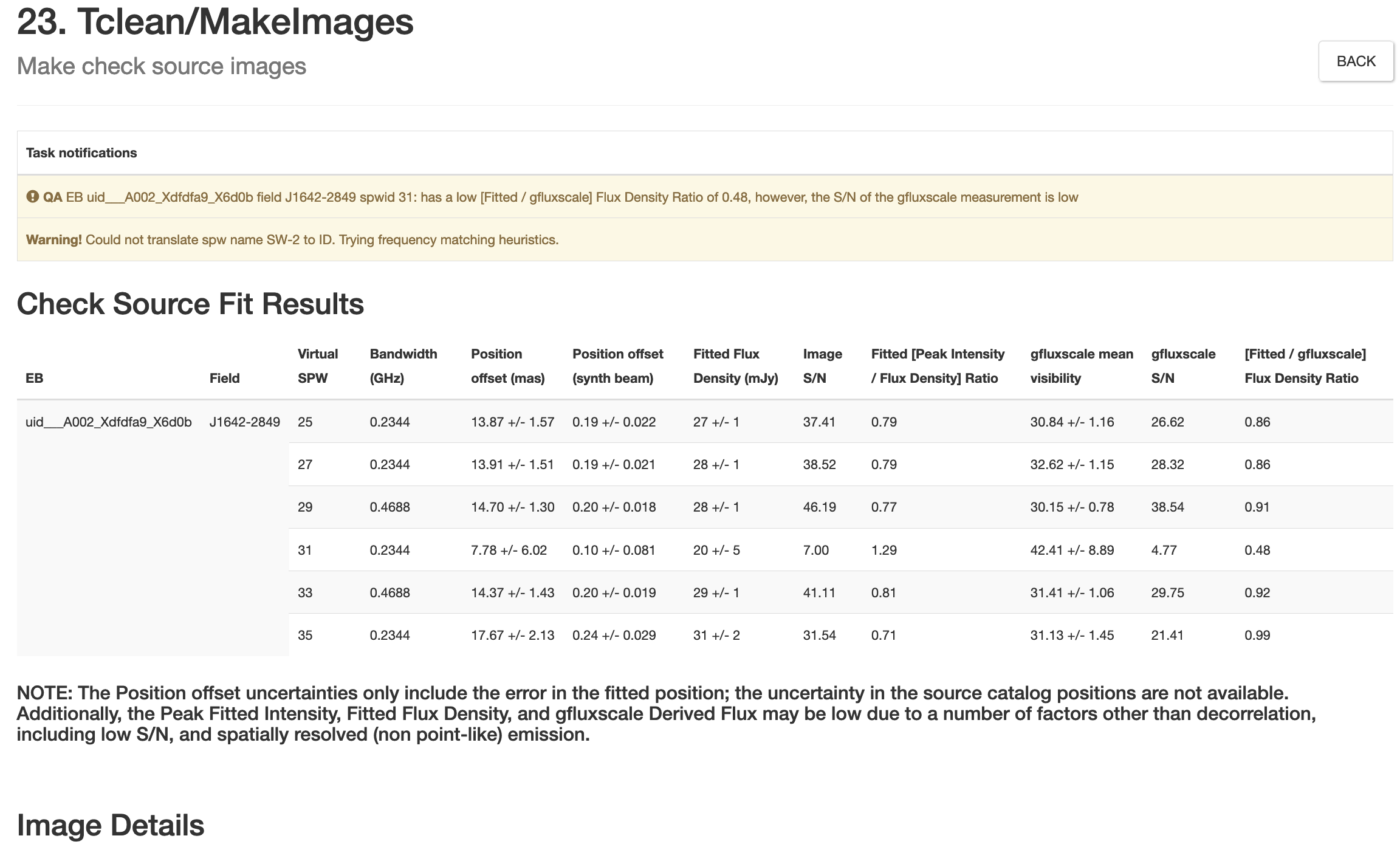
Example of the check source QA table in the WebLog.
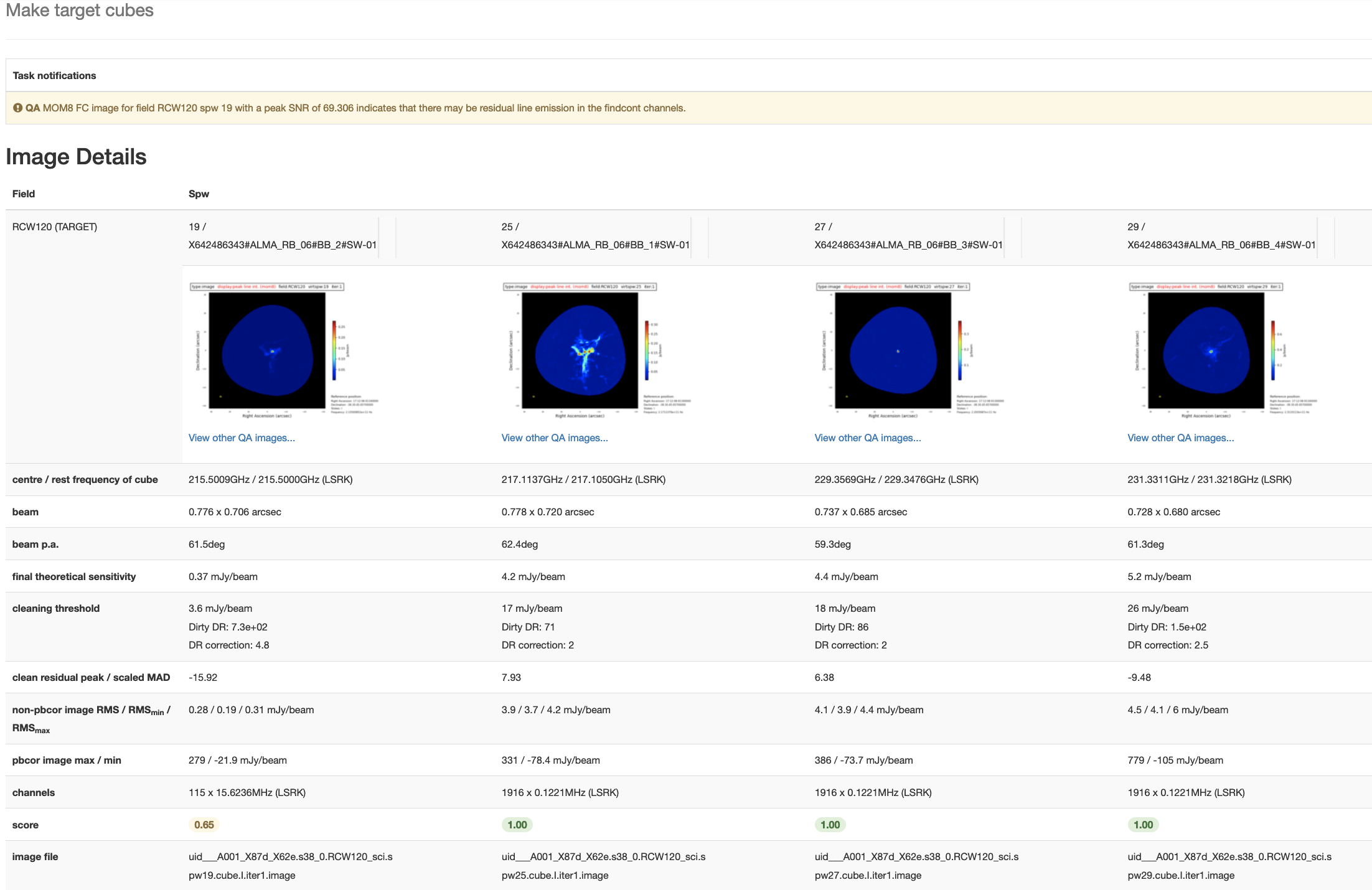
Example of the cube imaging WebLog page.
- Parameters:
vis -- The list of input MeasurementSets. Defaults to the list of MeasurementSets specified in the <hifa,hifv>_importdata task. '': use all MeasurementSets in the context Examples: 'ngc5921.ms', ['ngc5921a.ms', ngc5921b.ms', 'ngc5921c.ms']
target_list -- Dictionary specifying targets to be imaged; blank will read list from context
hm_masking -- Clean masking mode. Options are 'centralregion', 'auto', 'manual' and 'none'
hm_sidelobethreshold -- sidelobethreshold * the max sidelobe level
hm_noisethreshold -- noisethreshold * rms in residual image
hm_lownoisethreshold -- lownoisethreshold * rms in residual image
hm_negativethreshold -- negativethreshold * rms in residual image
hm_minbeamfrac -- Minimum beam fraction for pruning
hm_growiterations -- Number of binary dilation iterations for growing the mask
hm_dogrowprune -- Do pruning on the grow mask. Defaults to '' to enable the automatic heuristics calculation. Can be set to True or False manually.
hm_minpercentchange -- Mask size change threshold
hm_fastnoise -- Faster noise calculation for automask or nsigma stopping. Defaults to '' to enable the automatic heuristics calculation. Can be set to True or False manually.
hm_nsigma -- Multiplicative factor for rms-based threshold stopping
hm_perchanweightdensity -- Calculate the weight density for each channel independently. Defaults to '' to enable the automatic heuristics calculation. Can be set to True or False manually.
hm_npixels -- Number of pixels to determine uv-cell size for super-uniform weighting
hm_cyclefactor -- Scaling on PSF sidelobe level to compute the minor-cycle stopping threshold
hm_nmajor -- Controls the maximum number of major cycles to evaluate.
hm_minpsffraction -- PSF fraction that marks the max depth of cleaning in the minor cycle
hm_maxpsffraction -- PSF fraction that marks the minimum depth of cleaning in the minor cycle
hm_weighting -- Weighting scheme (natural,uniform,briggs,briggsabs[experimental],briggsbwtaper[experimental])
hm_cleaning -- Pipeline cleaning mode
tlimit -- Times the sensitivity limit for cleaning
drcorrect -- Override the default heuristics-based DR correction (for ALMA data only)
masklimit -- Times good mask pixels for cleaning
cleancontranges -- Clean continuum frequency ranges in cubes
calcsb -- Force (re-)calculation of sensitivities and beams
hm_mosweight -- Mosaic weighting Defaults to '' to enable the automatic heuristics calculation. Can be set to True or False manually.
overwrite_on_export -- Replace existing image products when h/hifa/hifv_exportdata is called. If False, images that would have the same FITS name on export, are amended to include a version number. For example, if oussid.J1248-4559_ph.spw21.mfs.I.pbcor.fits would already be exported by a previous call to hif_makeimags, then 'oussid.J1248-4559_ph.spw21.mfs.I.pbcor.v2.fits' would also be exported to the products/ directory. The first exported product retains the same name. Additional products start counting with 'v2', 'v3', etc.
vlass_plane_reject_im --
Only used for the 'VLASS-SE-CUBE' imaging mode.
Default: True
If True, reject VLASS Coarse Cube planes with high flagging percentages or outlier beam sizes (see the heuristics details below)
If False, do not perform the post-imaging VLASS Coarse Cube plane rejection. If the input value is a dictionary, the plane rejection heuristics will be performed with custom thresholds. The optional keys could be:
exclude_spw, default: '' Spectral windows to be excluded from the VLASS Coarse Cube post-imaging plane rejection consideration, i.e. always preserve.
flagpct_thresh, default: 0.8 The flagging percentage across the entire mosaic to be considered to be high flagging level for the plane rejection.
beamdev_thresh: default: 0.2 Threshold for the fractional beam deviation from the expected value required for the plane rejection.
parallel --
Use CASA/tclean built-in parallel imaging for individual scientific targets, or, perform continuum imaging of multiple target (calibrators) concurrently without the CASA/tclean built-in parallelization.
Options:
'automatic','true','false',True,False- Default:
'automatic'- optimizes the parallelization mode based on the imaging target type (scientific targets vs. calibrators) and the specific operation.
- Default:
- Return type:
Results
Notes
Three base QA scores apply to all imaging stages:
QA = 0.0 if the clean algorithm diverges.
QA = 0.34 if an expected image is not created.
Third score = ratio of non-pbcor noise-annulus rms (0.3-0.2 PB level) to the product of the theoretical noise and the DR correction factor. QA = 1.0 if that ratio <= 1.0; QA = 0.0 if >= 5.0; linearly scaled between 1 and 5.
Examples
Compute clean results for all imaging targets defined in a previous
hif_makeimlistcall:
>>> hif_makeimages()
Compute clean results overriding automatic masking choice:
>>> hif_makeimages(hm_masking='centralregion')