hif_findcont
Note
Parameters set to None will use intelligent defaults from the pipeline context.
Pass explicit values to override context defaults.
- hif_findcont(vis=None, target_list=None, hm_mosweight=None, hm_perchanweightdensity=None, hm_weighting=None, datacolumn=None, parallel=None)[source]
Identify line-free continuum frequency ranges for each science target and spw.
Creates dirty image cubes at native channel resolution (using
robust=1for optimal line sensitivity) for each science target and spw. The pipeline then runs thefindContinuumfunction to identify channel ranges likely free of line emission via the following steps:Joint-mask mean spectrum: SNR-based thresholds on the moment-0 (integrated) and moment-8 (peak) images define a 2-D joint mask. The mask is pruned to remove islands smaller than
max(4, int(beamAreaInPixels * minbeamfrac))pixels (minbeamfrac=0.3; 0.5 for ACA 7m if all islands are pruned). The mean spectrum over the mask is computed and analyzed to find line-free channels.Pre-smoothing: A boxcar smoothing kernel is applied to the mean spectrum prior to analysis. For Cycle 10+ data the kernel width is derived from the
spectralDynamicRangeBandwidthASDM attribute. For older data it is based on thenbinfactor from the precedinghif_makeimliststage, with additional heuristics to skip smoothing for wide + narrow spw combinations, already-labeled continuum spws, and cases of strong line emission (peak SNR > 10: nbin limited to 2 for 12m, 3 for 7m).Moment-difference contamination check: Line-free channels are used to form
mom8fcandmom0fcimages; the scaled-subtractedmomDiffimage peak SNR is computed. IfmomDiffSNR > 8(or > 11.5 for high-atm-variation spws), contamination is likely. Two remediation paths are tried: Amend Mask (logic code starts withA) or Only Extra Mask (code starts withE). Further steps include channel intersection, extra-mask, andautoLower(X,Y) iterations. The final logic path code and momDiffSNR are shown in the plot legend and the WebLog table.AllContinuum check: If a single range covers >= 92.5% of the channels (>= 91% for spws with < 75 channels), the spw is declared
AllContinuumand no cube is subsequently cleaned.
If a
cont.datfile already exists in the working directory, spws with pre-defined ranges are not re-analyzed; only spws not listed are processed. The resultingcont.datfile (LSRK frequency ranges) is used by subsequenthif_uvcontsubandhif_makeimagesstages.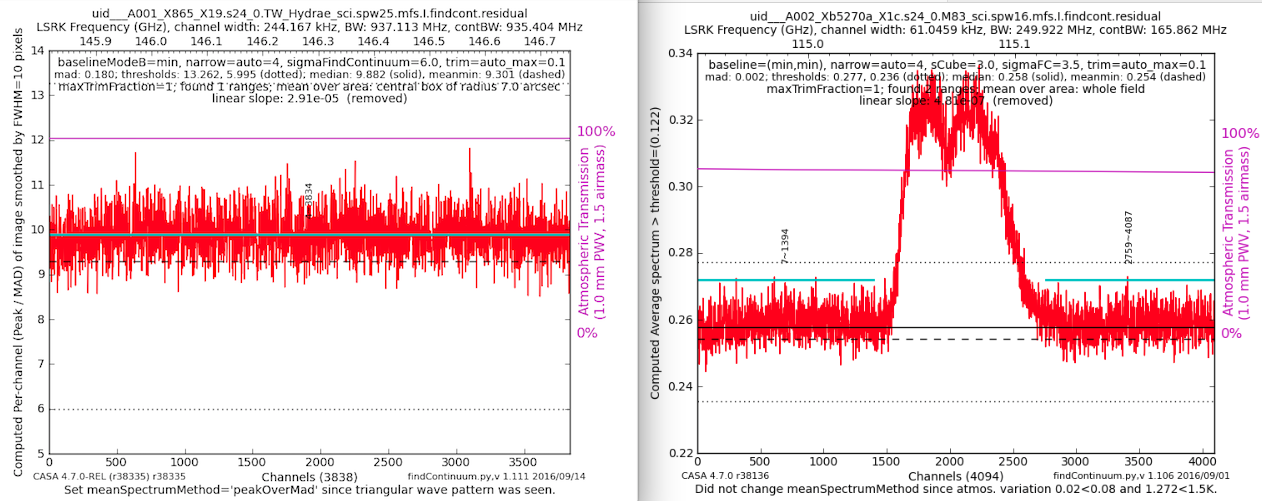
Two examples: entire spectral window identified as continuum (left) and two continuum ranges identified (right). Cyan horizontal lines mark the identified frequency ranges.
- Parameters:
vis --
The list of input MeasurementSets. Defaults to the list of MeasurementSets specified in the <hifa,hifv>_importdata task. '': use all MeasurementSets in the context
Examples: 'ngc5921.ms', ['ngc5921a.ms', ngc5921b.ms', 'ngc5921c.ms']
target_list -- Dictionary specifying targets to be imaged; blank will read list from context.
hm_mosweight -- Mosaic weighting. Defaults to '' to enable the automatic heuristics calculation. Can be set to True or False manually.
hm_perchanweightdensity -- Calculate the weight density for each channel independently. Defaults to '' to enable the automatic heuristics calculation. Can be set to True or False manually.
hm_weighting -- Weighting scheme (natural,uniform,briggs,briggsabs[experimental],briggsbwtaper[experimental])
datacolumn -- Data column to image. Only to be used for manual overriding when the automatic choice by data type is not appropriate.
parallel --
Use CASA/tclean built-in parallel imaging when possible.
Options:
'automatic','true','false',True,FalseDefault:
'automatic'
- Return type:
Results
Notes
QA = 1.0 if continuum frequency ranges were found for all spws; otherwise QA = fraction of spws for which a range was identified. QA = 0.0 if size mitigation previously failed.
Examples
Identify continuum frequency ranges for all science targets and spws:
>>> hif_findcont()