hifa_bandpassflag
Note
Parameters set to None will use intelligent defaults from the pipeline context.
Pass explicit values to override context defaults.
- hifa_bandpassflag(vis=None, caltable=None, intent=None, field=None, spw=None, antenna=None, hm_phaseup=None, phaseupbw=None, phaseupmaxsolint=None, phaseupsolint=None, phaseupsnr=None, phaseupnsols=None, hm_phaseup_combine=None, hm_bandpass=None, solint=None, maxchannels=None, evenbpints=None, bpsnr=None, minbpsnr=None, bpnsols=None, combine=None, refant=None, minblperant=None, minsnr=None, solnorm=None, antnegsig=None, antpossig=None, tmantint=None, tmint=None, tmbl=None, antblnegsig=None, antblpossig=None, relaxed_factor=None, niter=None, hm_auto_fillgaps=None, parallel=None)[source]
Flag outlier visibilities in the bandpass calibrator data.
Calculates an initial phase-up and bandpass solution (see
hifa_bandpass), applies it temporarily, then identifies outlier visibilities by statistically examining the scalar difference of calibrated amplitudes minus model amplitudes for the bandpass calibrator. If flags are found, a second iteration is performed. At the end the flagging state from before this task is restored and all flags found here are applied.Only amplitude outliers are assessed; the phase of the data is not evaluated.
The WebLog shows two sets of amplitude vs. uv-distance plots for the bandpass calibrator: before flagging and after flagging. If no data were flagged, the 'after' plots are not generated.
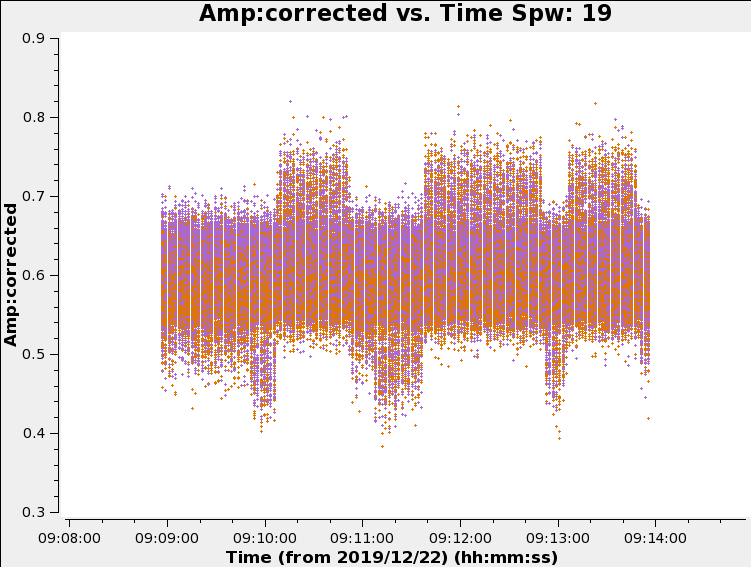
Before flagging: example of outlier amplitudes.
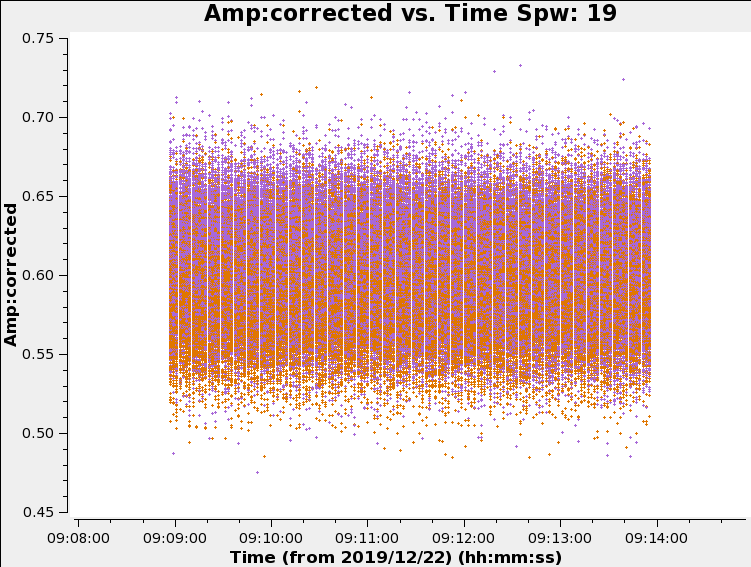
After flagging: the same data with outlier visibilities removed.
- Parameters:
vis --
List of input MeasurementSets. Defaults to the list of MeasurementSets specified in the pipeline context.
Example:
vis=['ngc5921.ms']caltable --
List of names for the output calibration tables. Defaults to the standard pipeline naming convention.
Example:
caltable=['ngc5921.gcal']intent --
A string containing a comma delimited list of intents against which the selected fields are matched. Set to
intent=''by default, which means the task will select all data with the BANDPASS intent.Example:
intent='*PHASE*'field --
The list of field names or field ids for which bandpasses are computed. Set to field='' by default, which means the task will select all fields.
Example:
field='3C279',field='3C279,M82'spw --
The list of spectral windows and channels for which bandpasses are computed. Set to spw='' by default, which means the task will select all science spectral windows.
Example:
spw='11,13,15,17'antenna -- Set of data selection antenna IDs
hm_phaseup --
The pre-bandpass solution phaseup gain heuristics. The options are:
'snr': compute solution required to achieve the specified SNR'manual': use manual solution parameters'': skip phaseup
Example:
hm_phaseup='manual'phaseupbw --
Bandwidth to be used for phaseup. Used when
hm_phaseup='manual'.Example:
phaseupbw=''to use entire bandpassphaseupbw='500MHz'to use central 500MHz
phaseupmaxsolint --
Maximum phase correction solution interval (in seconds) allowed in very low-SNR cases. Used only when
hm_phaseup='snr'.Example:
phaseupmaxsolint=60.0phaseupsolint --
The phase correction solution interval in CASA syntax. Used when
hm_phaseup='manual'or as a default if thehm_phaseup='snr'heuristic computation fails.Example:
phaseupsolint='300s'phaseupsnr --
The required SNR for the phaseup solution. Used to calculate the phaseup time solint, and only if
hm_phaseup='snr'.Example:
phaseupsnr=10.0phaseupnsols --
The minimum number of phaseup gain solutions. Used only if
hm_phaseup='snr'.Example:
phaseupnsols=4hm_phaseup_combine --
The spw combination heuristic for the phase-up solution. Accepts one of following 3 options:
'snr', default: heuristics will use combine='spw' in phase-up gaincal when SpWs have SNR < phaseupsnr (default = 20).'always': heuristic will force combine='spw' in the phase-up gaincal.'never': heuristic will not use spw combination; this was the default logic for Pipeline release 2024 and prior.
Example:
hm_phaseup_combine='always'hm_bandpass -- The bandpass solution heuristics. The options are:
'snr': compute the solution required to achieve the specified SNR'smoothed': simple 'smoothing' i.e. spectral solint>1chan'fixed': use the user defined parameters for all spwssolint -- Time and channel solution intervals in CASA syntax. Default is solint='inf', which is used when
hm_bandpass='fixed'. Ifhm_bandpass='snr', then the task will attempt to compute and use an optimal SNR-based solint (and warn if this solint is not good enough). Ifhm_bandpass='smoothed', the task will override the spectral solint with bandwidth/maxchannels.maxchannels --
The bandpass solution 'smoothing' factor in channels, i.e. spectral solint will be set to bandwidth/maxchannels Set to 0 for no smoothing. Used if
hm_bandpass= 'smoothed'.Example:
maxchannels=240evenbpints --
Force the per spw frequency solint to be evenly divisible into the spw bandpass if
hm_bandpass= 'snr'.Example:
evenbpints=Falsebpsnr --
The required SNR for the bandpass solution. Used only if
hm_bandpass='snr'.Example:
bpsnr=30.0minbpsnr --
The minimum required SNR for the bandpass solution when strong atmospheric lines exist in Tsys spectra. Used only if
hm_bandpass='snr'.Example:
minbpsnr=10.0bpnsols --
The minimum number of bandpass solutions. Used only if
hm_bandpass='snr'.Example:
bpnsols=8combine --
Data axes to combine for solving. Axes are
'','scan','spw','field'or any comma-separated combination.Example:
combine='scan,field'refant --
List of reference antenna names. Defaults to the value(s) stored in the pipeline context. If undefined in the pipeline context defaults to the CASA reference antenna naming scheme.
Example:
refant='DV06,DV07'minblperant --
Minimum number of baselines required per antenna for each solve. Antennas with fewer baselines are excluded from solutions.
Example:
minblperant=4minsnr --
Solutions below this SNR are rejected.
Example:
minsnr=3.0solnorm -- Normalise the bandpass solution; defaults to
True.antnegsig --
Lower sigma threshold for identifying outliers as a result of bad antennas within individual timestamps.
Example:
antnegsig=4.0antpossig --
Upper sigma threshold for identifying outliers as a result of bad antennas within individual timestamps.
Example:
antpossig=4.6tmantint --
Threshold for maximum fraction of timestamps that are allowed to contain outliers.
Example:
tmantint=0.063tmint --
Initial threshold for maximum fraction of 'outlier timestamps' over 'total timestamps' that a baseline may be a part of.
Example:
tmint=0.085tmbl --
Initial threshold for maximum fraction of 'bad baselines' over 'all baselines' that an antenna may be a part of.
Example:
tmbl=0.175antblnegsig --
Lower sigma threshold for identifying outliers as a result of 'bad baselines' and/or 'bad antennas' within baselines (across all timestamps).
Example:
antblnegsig=3.4antblpossig --
Upper sigma threshold for identifying outliers as a result of 'bad baselines' and/or 'bad antennas' within baselines (across all timestamps).
Example:
antblpossig=3.2relaxed_factor --
Relaxed value to set the threshold scaling factor to under certain conditions (see documentation of the underlying correctedampflag task).
Example:
relaxed_factor=2.0niter --
Maximum number of times to iterate on evaluation of flagging heuristics. If an iteration results in no new flags, then subsequent iterations are skipped.
Example:
niter=2hm_auto_fillgaps -- If True, then the
hm_bandpass='snr'or 'smoothed' modes, that solve bandpass per SpW, are performed with CASA bandpass task parameter 'fillgaps' set to a quarter of the respective SpW bandwidth (in channels). If False, then these bandpass solves will use fillgaps=0. Thehm_bandpass='fixed'mode is unaffected byhm_auto_fillgapsand always uses fillgaps=0.parallel --
Process multiple MeasurementSets in parallel using the casampi parallelization framework.
Options:
'automatic','true','false',True,FalseDefault:
None(equivalent toFalse)
- Return type:
ResultsList[Results]
Notes
The 'before' flagging fraction shown in the summary table may differ from the 'after' fraction shown in
hifa_flagdata, because the 'before' summary is computed on a data set that has already had calibration tables temporarily applied (and therefore some flagging already propagated). This is intentional: the before/after summary is designed to show clearly how much new flagging is introduced by this task.QA = 1 - (fraction of data newly flagged). An additional score of 0.8 is assigned if any spw has an antenna that is fully flagged.
Examples
Run with recommended settings to create bandpass solution with flagging using recommended thresholds:
>>> hifa_bandpassflag()