hifa_diffgaincal
Note
Parameters set to None will use intelligent defaults from the pipeline context.
Pass explicit values to override context defaults.
- hifa_diffgaincal(vis=None, flagging_frac_limit=None, hm_spwmapmode=None, missing_scans_frac_limit=None)[source]
Derive SpW phase offsets from differential gain calibrator.
This task creates the spectral window phase offset table used to allow calibrating the "on-source" spectral setup with phase gains from a "reference" spectral setup. Currently this setup with two different SpectralSpecs is used by the band-to-band mode, for a high and low frequency band.
A bright point source quasar, called the Differential Gain Calibrator (DIFFGAIN) source, is used for this purpose. This DIFFGAIN source is typically observed in groups of interleaved "reference" and "on-source" scans. These blocks typically occur once at the start and once at the end of the observation. In very long observations, there may be a group of scans occurring during the middle.
The procedure for the phase calibration process is as follow:
referencecalibration uses the "reference" spectral setup, the "low" frequency for band-to-band observations. The solint is fixed as 'inf' (i.e. solutions are made per scan). Spectral window combination is governed by the hm_spwmapmode options described below. In standard pipeline operationautois used - basing spw combination upon SNR and flagging level. These reference phase solutions are later applied on-the-fly while solving the (band-to-band)phase offset. The premise being that thereferencesolutions correct for atmospheric phase variability.phase offset(i.e. the band-to-band correction) calibration uses the "on-source" spectral setup, the "high" frequency for band-to-band observations. The abovereferencephase corrections are applied on-the-fly using a linearPD interpolation - this corrects (scales) the phases according to the different ratio of the frequency bands. The solint = 'inf' and each group of scan blocks (typically at the start and end of the observation) are combined respectively. The phase offset solution generally comprises of 2 time solutions per spw, per polarization. Spectral window combination is governed by the hm_spwmapmode options described below.autois used - basing spw combination upon SNR and flag data. These solutions are stored in the pipeline context for later application to the TARGET and CHECK intent(s).residual offsetsolutions are produced by applying bothreferenceand band-to-bandphase offsetsolutions to the 'on-source' DIFFGAIN intent on-the-fly, and subsequently solving phases per spw, per scan using solint='inf'. Spectral window combination is governed by the hm_spwmapmode options described below.autois used - basing spw combination upon SNR and flagging level.
Residual solutions pre-apply all corrections and solve for the scan-based DIFFGAINSRC phases. These are designed to scatter about zero degrees with no drift. Residuals not limited by SNR should ideally be within +/-30 deg; good-conditions data should be within +/-50 deg.
As of PL2025, low-SNR heuristics allow
combine='spw'to be used in any of the three solve steps. The heuristic is triggered if (i)combine='spw'was required inhifa_spwphaseupfor the DIFFGAIN intent, or (ii) a temporarygaincalshows that the fraction of flagged or missing solutions would exceed 0.7 of the total.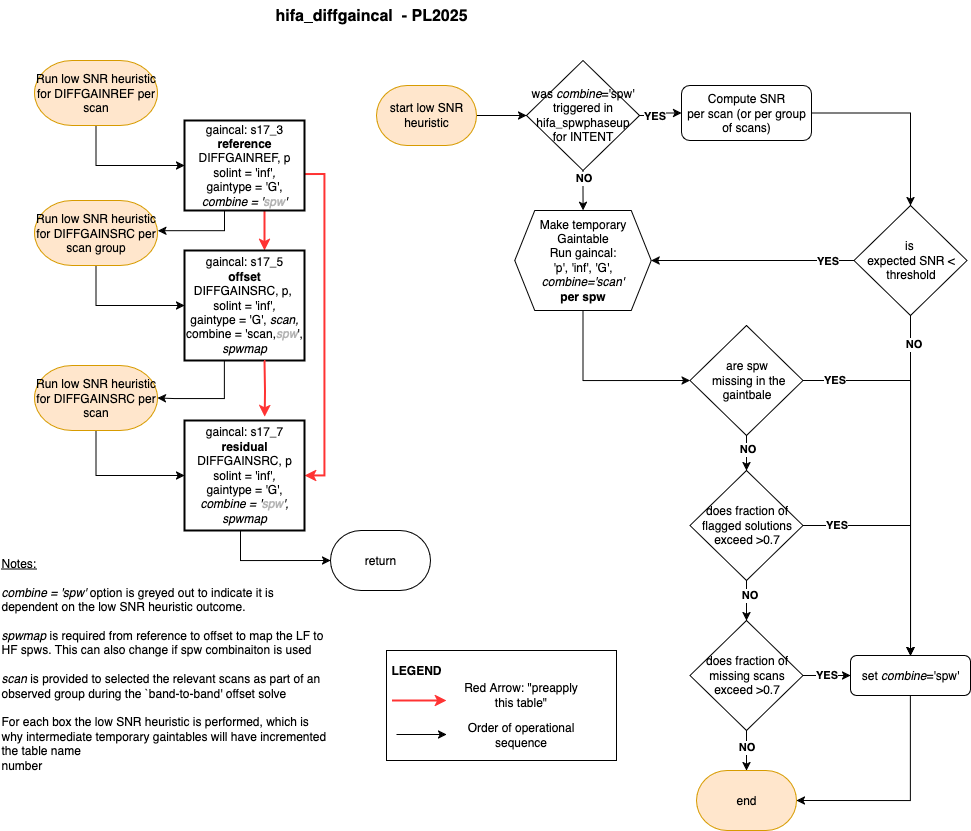
Left: gain solution workflow with low-SNR heuristic before each
gaincal. Right: low-SNR heuristic logic for spectral window combination.¶- Parameters:
vis --
The list of input MeasurementSets. Defaults to the list of MeasurementSets specified in the pipeline context.
Example:
['M32A.ms', 'M32B.ms']flagging_frac_limit -- if the fraction of flagged data in the temporary phase gaintable exceeds this limit then SpW combination is triggered.
hm_spwmapmode --
The spectral window mapping heuristic mode. The options are:
'all': SpW combination is forced for the diffgainlow-frequency reference intent solutions, the diffgain high-frequency source intent solutions (actual band-to-band offsets), and for the diagnostic residual phase offsets on the diffgain high-frequency source intent.
'auto': Assess need for SpW combination based on SpwMappingfrom hifa_spwphaseup, and where necessary check the gaintable for missing SpWs / too many flagged data / too few scan solutions.
'both': SpW combination is forced for the diffgainlow-frequency reference intent solutions and for the diagnostic residual phase offsets on the diffgain high-frequency source intent.
'offset': SpW combination is forced for the diffgainhigh-frequency source intent solutions (actual band-to-band offsets).
'reference': SpW combination is forced for the diffgainlow-frequency reference intent solutions.
'residual': SpW combination is forced for the diagnosticresidual phase offsets on the diffgain high-frequency source intent.
Example:
hm_spwmapmode='auto'missing_scans_frac_limit -- if the fraction of missing scans in the temporary phase gaintable exceeds this limit then SpW combination is triggered.
- Return type:
ResultsList[DiffGaincalResults]
Notes
QA sub-scores:
1.0 if each caltable (reference, band-to-band offset, residual) is successfully produced; 0.0 if any table is missing (which invalidates the calibration).
0.9 (informative only) if
combine='spw'was required for any of the three solve steps; 1.0 otherwise.
Only used in band-to-band (diffgain) recipes.
- Returns:
The results object for the pipeline task is returned.
- Return type:
ResultsList[DiffGaincalResults]
Examples
Derive SpW phase offsets from differential gain calibrator.
>>> hifa_diffgaincal()